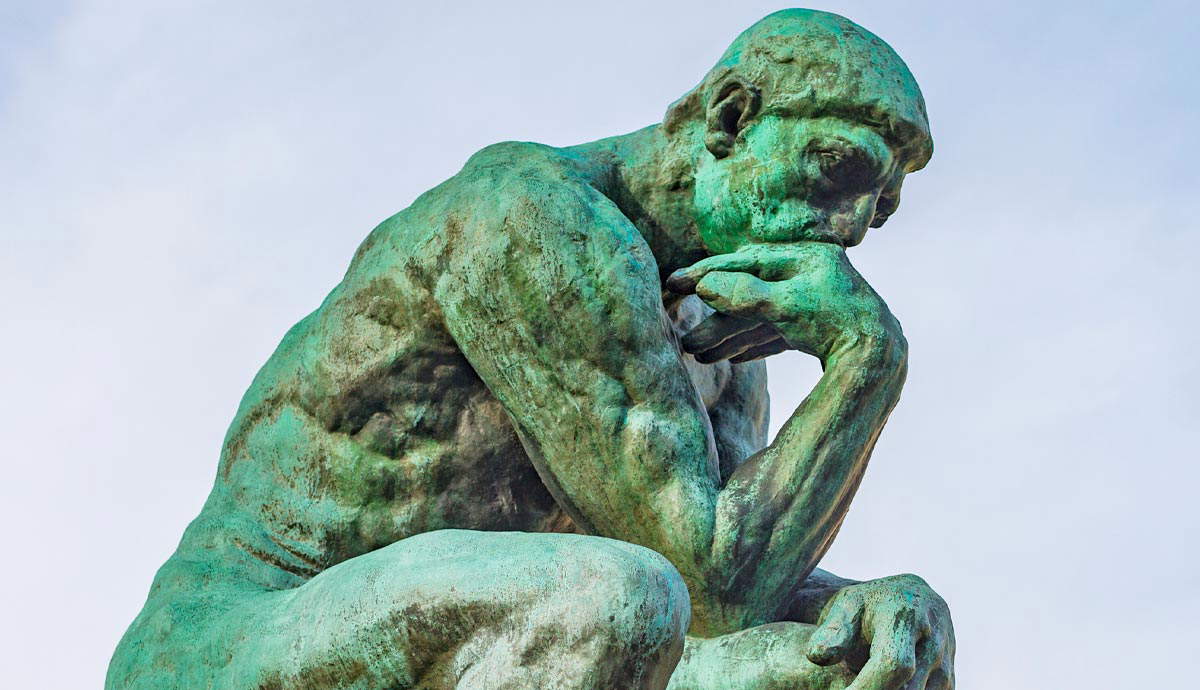
What is intelligence?
Some people have it, some think they have it, some want it, and some think they want it. Intelligence is one of those things we claim to recognize but struggle to define. At times, we point to a clever solution, or an ingenious insight and say “that is intelligent”, yet when we try to pin down the essence of what we’re pointing at, the concept fragments. In the modern paradigm, intelligence serves at once as a stand for three different things: an action, a metric, and a vague idea of inherent cognitive worth. Rather than being incidental, this is precisely the root of the problem. The cart has been placed before the horse. Employing a precise looking metric - the IQ test - to quantify a concept that has never been coherently defined, we use the resulting numbers to retroactively justify the very definition we presume to measure. As a result, this circular logic has trapped us in a paradigm where we measure what we can, rather than seeking to understand what is.


To break this cycle, we need to return to the source, and the key lies in the word itself, particularly in its etymology. Intelligence and intelligible share the Latin root intelligere: inter (between) and legere (to gather, to choose, to read). This etymology unveils intelligence not as a static possession, but as active relationship; the etymology reveals intelligence as the active capacity “to read between”, to discern patterns and meaning, thereby rendering the world intelligible. Intelligence is therefore a relational event that unfolds in the relationship between the subject and the world. To be intelligent is to engage in the perpetual act of interpretation, of translating patterns, symbols, and structures of reality, into a coherent meaning. The world itself is a kind of text, rich with potential intelligibility, and with mind as its reader. The two exist in a co-creative polarity: an intelligible world invites reading, and an intelligent mind searches for something to read. An intelligent being is one that can make sense of its context, and an intelligent world is one that can be meaningfully read. They are two sides of the same coin. This dynamic dismantles a dominant trend we’ll call the “banking” model of knowledge, where a conflation between information storage and comprehension is made. Surely the storage of information allows one to fashion from it understandings and readings, but the mere fact of acquiring factoids alone does not constitute an intelligent person. In addition to this trend, another trend is dismantled, one we’ll be calling the “processor” model, which conflates “computational speed” with genuine insight. True intelligence is not measured by what one has, but by the depth and relevance of the connections formed in dialogue with reality. This relational view even carries a moral/normative dimension. The highest intelligence becomes a form of literacy, a capacity to read a forest as an ecosystem or living domain, a person as a history or living thing with a past and a future. The intelligent person is engaged in the ongoing project of rendering the world meaningful, and in doing so, participating in the very unfolding of its intelligibility.
This perspective also reveals that intelligence is not the sole province of the conscious human mind. An object within a coherent system possesses a kind of contextual intelligence. Its very form and function “read” and answer the demands of the system (or mind) it helps constitute, rendering this mind stable, operational, and of course, intelligible. A perfect geometric crystal is an implicit argument of natural law. Its facets express, with an almost perfect logic, the mathematical constraints of molecular forces and symmetry, unified in the higher ideality of its intelligibility. The deepest form of intelligibility, or intelligence, is here a sense in which an object, or perhaps even a logic or pattern, which belongs “natively” (or rather colloquially) to a different system altogether, existing in the fabric of another. True intelligence, as the capacity to “read between”, excels at this cross-contextual mapping (and here I am to make a case for a resurgence in renaissance men and generalist education, but let’s stay on topic). Consider a very compelling example which came to me many years ago: take the case of a virologist who becomes an exceptional social media manager. Their expertise is not in memes, but in the underlying dynamics of virality. The conditions of a host environment, the thresholds of contagion, perhaps even the mutation of a message (which translates to memetics), in addition to an intuitive understanding of pathways of transmission are what they are educated in. They possess a profound literacy in one system (biological contagion), whose abstract relational logic is isomorphic to another (informational contagion). As such, their intelligence is not demonstrated by storing facts about “trending topics” or “viruses”, but by successfully grasping the deeper intelligibility which interacts with and governs both domains. In this sense, the phrase “going viral” in the context of the virtual world has much more in common with the natural world than it may seem. This is the hallmark of true intelligence, grasping the intelligible form of a process so clearly that its echo can be discerned in a seemingly foreign territory.
The object itself is the solution to a problem, it is an intelligent object that makes the invisible structure/relationality of its context legible. If one would like to interpret the previous sentence another way, the heuristic in systems thinking: the purpose of a system is what it does can serve us well. The object is in a dialogue with the whole. Life itself is this principle incarnate and active. A growing root navigates soil not by calculating as if it had the same kind of mind we do, but by being-there in a living dialogue with the whole of nature and with the whole of itself. Encountering gravity, moisture, obstacles, temperature, and more, it successfully reads between these variables of its environment to solve the problem of survival. An ecosystem self-regulates, and within this system, its species and processes are locked in a dance of change. Biological life cannot possibly be a passenger in an intelligible universe. It is itself a creative form of that universe’s fundamental intelligibility as a continuous morphing act of interpretation and response that perpetuates the very conditions for being read. This chain of intelligibility implies a culminating coherence: the most complete, self-sufficient, and all-encompassing “mind” or system, which philosophy and theology would term the Absolute, or God. By this same logic, this would be the ultimate intelligibility. It would be that in which all partial contexts find their final reference, the absolute source of pattern and meaning in which every subsidiary “reading”, from the smallest particle to the highest angels, coheres, and is perfectly rendered intelligible.
Let us return from the heights of this overview and demonstrate a more practical scenario. This model also clarifies a common paradox we find today: The person hailed as “smart” who fails to live up to their potential. This designation isn’t based on an abstract hidden quality, it is a verdict based on some prior demonstration of a moment where they successfully produced an insight or created something. In other words, the only reason they are said to be intelligent is because they have showed it in the past, and the only reason they aren’t at this moment, is because of some disconnect between them and the world. Their very capacity created the expectation. Subsequent failure wouldn’t be a mismeasurement of some internal asset, failure is what results from a breakdown in their ongoing relationship with the world. Perhaps a person is going through a depressing period in thier life, perhaps they lack confidence for this or that reason. Nonetheless, what this situation highlights is a moment of dialectic which constitutes intelligence/intelligibility. It requires both the capacity to discern, and the concrete will to engage. To call someone intelligent is to recognize a pattern of successful past readings; to say they are wasting their intelligence is to observe a present refusal to enter into that meaningful dialogue. Thus, potential cannot be a ghost in the machine. Potential, in the context of man, is the unfulfilled promise of the relationship between a particular mind and the world it is capable of reading. The person and their potential are not separate, they are two descriptions of the same relational capacity, seen from the vantage point of past manifestation and future possibility. Truly, it is wasted potential for someone who has the capacity to be in the world and contribute to its intelligibility be plagued by either conditions outside themselves, or by internal ailments needed to be worked through.
It’s not a surprise, then, that those who brandish the highest IQ scores are rarely the ones who change the world. Consider MENSA, a group defined by this exclusive metric. Its members collectively have not produced the defining innovations, art, or social transformations neither of our age, nor historically which have defined Western civilization. The common retort in defense of this metric is that world-changers like Einstein (I will grant that he has changed the paradigm of physics with GR and SR, not that is true) also had high IQs, is a sleight of hand. It mistakes an occasional correlation for a causal necessity, while ignoring the vast majority of high-IQ individuals who produce nothing of comparable significance. This defense commits a few errors we will fully expand on later, but of which we can get a rough idea of here. Firstly, a conflation between the narrow skill of test-taking abstraction with the generative capacity and action that remakes and co-participates in reality. Secondly, it overlooks the essential non-IQ factors such as perseverance, moral vision, and the capacity to find problems rather than solving pre-framed ones. Third, it cherry-picks historical geniuses post-hoc, using their legendary status to validate the metric rather than questioning why the metric fails to predict such genius in the living. This is not to say high scorers are devoid of talent, only that test scores capture a shadow of what’s required to really “read between” the lines of reality and “write a new chapter”, so to say. I suppose this clarification protects against the straw manned response of saying “Iapetus thinks someone with an IQ of 60 can change the world”. No, I want to problematize everything about this modern approach, including the biology-mind/IQ connection. Have you, for example, heard of the French man missing 90% of his brain, and despite that having an IQ of 84 and living a relatively normal life? The world is bigger than it seems.
Cross-contextual mapping of this kind points towards the idea that intelligence is not a bundle of separate, domain-specific modules, but a unitary core faculty. It is one unified foundational capacity for relationship discernment, and yes, problem-solving. What varies is not the kind of intelligence, but the medium and level it works at. Given that this unified capacity involves the discernment of patterns of relationship, the artist and the scientist, the poet and the philosopher, ultimately perceive the same intelligible pattern in the world, but one renders it as metaphor and work which stirs the soul, while the other translates it into an equation or logical explication, which just as much may stir the soul, but nonetheless is conveyed differently than the former two. Moreso, the very reason our very “reading the world” transforms from age to age is not accidental. It follows from a necessary evolution in the way we make intelligibility intelligible to us in the first place. For if meaning was fully available in its conveyance at the point of contact, it would imply we have a proximity to the divine mind of God that goes in contrast to everything we know and can know at this point in time. It would be a totalizing knowledge entirely alien to the human condition. Instead, we don’t encounter the “whole” truth, we approach it through a succession of partial evolving perspectives, which themselves have a telos (which I will not cover in this essay). The intelligence, or intelligibility, of millennia past is in continuity with the one today. Each stage in how we make the world intelligible is therefore a corrective to the limitations of the last, and a step in the long awakening of the mind to its own implicit potential and to the realities it seeks to know. We think we know what intelligence is. We measure it in numbers, rank it in percentiles, use it to categorize people, and sort or determine the worth of children and adults. What if the most “intelligent” thing you could do today is to recognize that everything we think we know about intelligence is misguided and, in some cases, harmful? What if the modern concept is not only flawed, not only a category error, but misconceived entirely and disconnected from the culmination of it prior to its current ~500 year long iteration? As you continue, this essay demonstrates that the fragmented phantom of intelligence we have today, is inadequate. Additionally, it demonstrates that there is necessity in tracing its disappearance from the universe, into the skull, and onto a Scantron sheet, in order to place it back where it ought to be.
The History of Consciousness
If intelligence is the act of “reading between” the self and the world, then the question which guides our investigation is: “Where does this intelligibility come from”? For us modern men (and women), the answer is passive, mechanical nature. The “reading” is a private activity of our individual brains. However, this is a recent, and might I add, very impoverished answer. To grasp the full depth of our definition, we must recognize that intelligence and consciousness are two facets of the same event. Consciousness (from con [with] + and scire [to know]) is, simply put, our state of being with knowledge, the condition of a being capable of rendering its world intelligible. Therefore, the history of consciousness is the history of intelligibility itself. Not the intelligibility of things per se, but intelligibility in general. In effect, it is the history of the evolving method of that rendering. Each cultural age represents a distinct schooling of the human spirit in a specific mode of “reading”. In the not-too-distant past, one would not say “I think”, but “it thinks in me”. This is since each mode is indicative of a different order of intelligibility than another. Likewise, our current “stage” or mode of consciousness differs from the last. In order to understand our current paradigm, we must journey to a time when the source of intelligibility was not found in the skull, but experienced in the world as a revelation from a living totality/universe.
Note: Jean Gebser’s terminology will be used here and there in addition to Steiner’s terminology in order to describe the structural stages that characterize the relationship between intelligibility and consciousness. There is great overlap between what they describe, however they are different projects.
Indian
Before the soul of man could make what it saw before it intelligible, the human soul needed to clarify the “that” of what it was making intelligible in the first place. The faculty necessary for the that-ness of intelligibility is the very capability to recognize that there is something meaningful to be grasped. It was the Indian cultural age which provided this certainty through an inward spiritual memory. It established the foundation that being is spiritual in essence. Without this anchor, all subsequent exploration risks concluding that the material world is the only reality. The Vedanta and Upanishads are fundamentally concerned with transcending the material world (Maya) and realizing the ultimate spiritual unity (Brahman), or ideal/total unity for you Hegelheads, through the inward turning and contemplation of knowledge (Jnana). The famous dictum Tat Tvam Asi, or Thou art That, captures this age’s focus. The individual soul is not to understand the world, but to continuously remember and establish its identity with the universal “source”. Intelligibility/intelligence here is the intuitive recognition of a pre-existing, all-encompassing spiritual, or ideal, whole.
As a result, the first attitude of intelligibility is one of undifferentiated unity. Gebser would term this the archaic structure, where consciousness is an undeveloped embedding in the world. Consciousness here has not yet become self-reflective, it lies in an immersive state where inner “thought”, and outer “being”, or event, are indistinguishable. Meaning isn’t deciphered, there isn’t room for a stage of explicit recursion. Instead, there is a conscious anchoring in undifferentiated spiritual unity, which provides the necessary ground for all subsequent development. Without this anchor, man’s turn toward the world risks complete disorientation.
Persian
Stages of positivity always necessarily invite negation. What this means for consciousness, after establishing the positive unity of self and world, is that it must learn discernment. Zoroastrianism presents the cosmos as a grand battle between the spirit of light, truth, and order (Ahura Mazda), and the spirit of darkness, falsehood, and chaos (Angra Mainyu, or Ahriman. We will see him return later). Man here has a moral, or normative, duty to cultivate good creation (such as agriculture and truth-telling) and fight against corruption. An active will-centric engagement finds intelligibility discerning between good and bad in every aspect of life, and as a result, choosing sides. At this stage, existence itself is unified with morality, or normativity, from the perspective of consciousness. The notion that “being is good” can be found in various proofs today, but for it to be intelligible to man, it was first established concretely here. In Gebser’s terms, we would see the magical structure as dominant. We find that consciousness is enacted through ritual, rhythm, and eventually, a magical empathy with natural forces. Magical is the correct word here, since magic is the immediate attempt of subjectivity to control nature directly, without mediation by an objective universality. The archaic is a zero-point of “embedding”, while the magical, is marked by point-like, group-oriented awareness and a fluid, pre-perspectival sense of space and causality. This magical event characterizes the moment of pre-conscious differentiation, before consciousness awakes to narrative/myth in the next section. Steiner would correctly see this as the moment of dream-like instinctive clairvoyance (which has a technical definition in his system, although it is related to the everyday understanding) where the human being lived in an unconscious unity with cosmic beings, forces, and idealities. Both would agree that this stage is indicative of a profound connection, or unity, yet lacks individual freedom and the capacity for critical thought and critical self-awareness (which, of course, is implied by differentiation).
To better grasp the distinction between the archaic and the magical, the Aboriginal concept of Dreamtime, has a direct correlate here, and is also reflective of Steiner’s descriptions of pre-historic consciousness. The individual and group are not yet fully distinct, and the human and natural worlds are bound in a web of participation. In Dreamtime, the Ancestor Beings, the land, the people, etc. are all part of a single continuous being. A person is not just on the land, they are a particular part of it, descended from, and in continuity with, the Ancestor who formed it. This description is a quintessential example of the magical-participatory relationship. Time is fluid, it lacks linear sequentiality, and so Dreamtime is not “a long, long time ago”, it is the eternal now, everywhen. Ritualistic actions as a result are not commemorative events, they are actions which invoke a participation and re-actualization of the ongoing creative power of Dreamtime (and thus, like the moral dimension of the Zoroastrian belief, there is a moral imperative here of maintenance to the land), or of intelligibility and intelligence. However, it is also worth noting that there is some overlap with the next stage we will discuss, the mythic structure. Because the Dreamtime involves narrative and has this image-based quality, which is a hallmark of the mythic structure, it can be said to be a preserved form of what Steiner calls “old Imaginative consciousness”, or instinctive clairvoyance. The good news is that this reveals that these structures are not rigid boxes, but interpenetrating states of being. Dreamtime stands as a testament to this fluidity, and so is not the “primitive” form of the later mythic structure. The core of consciousness remains magical, while its expression takes on a narrative image-based form.
Egyptian-Chaldean
The mythic structure is the stage where consciousness, intelligibility, intelligence, however you want to call it, awakens to polarity and rhythm. It expresses itself in symbols and images, or narratives/myths (hence mythic structure). The world is perceived as a drama of spiritual beings/idealities and forces. The participatory engagement of the Magical structure is crystallized. So it follows that the diffuse forces found in Persia coalesce into the images, symbols, and myths of Gods. Intelligibility is a matter of participating in a struggle here no longer, it is now concerned with decoding the divine language written into the world.
Note on myth: mythology often times has this colloquially implied meaning of “created” or fictional, but an etymological review of the word reveals mythology as the study of what was uttered/spoken. The modern implication that these narratives and stories are all misguided, that, because they didn’t have the scientific tools we do now, they didn’t have the truth, assumes our ancestors were incompetent versions of ourselves, stumbling and bumbling towards a truth only we possess. For if they were so incompetent, the possibility of generating “superior” beings such as us surely wouldn’t come to be. The steel-manned position of ancient attitudes would view them at the very minimum as working with what they had at the time. It would see that myth and stories are not a failed attempt at our kind of fact, but a sophisticated vehicle of a different order. In order to convey important information (such as regarding the human condition, the universe, the moral order, or the great chain of being), a medium and method that does not risk the integrity of that message is needed which accomplishes these things. The ancients developed a peerless method here. Thus, the story and symbol serves as the perfect vehicle to convey such information. Statues, carvings, stories, and so on have the express purpose of preserving and imparting wisdom. The refusal to engage with this reality and reduce it to primitive fiction is not a sign of sophistication. Quite the opposite, actually. It describes a very specific kind of poverty in our own current mode of understanding, which is an attitude we will address later on.
The Egyptians and Chaldeans perfected this “reading”. The movements of the stars in Babylonian astrology (which also deserves a standalone article) do not exist as flat astronomical data. They, instead, reveal the will of the universe in narrative form. For example, the journey of Ra, or the drama of Osiris’s death and re-birth are not natural events we look to and find in the natural world using our mode of consciousness. They’re chapters in a sacred story where time is cyclical, among other things. Intelligibility is required to learn this “symbolic script”, a task for the astronomer, priest, or the initiated. This here is a historical demonstration of Steiner’s “imaginative consciousness”. Consciousness awakens to polarity and rhythm and perceives the drama of the world. The self, in the face of this drama, becomes a receiver and interpreter of these revelations, and moves beyond the “magical participation”, found in the previous age, towards a structured understanding of the world/universe, but still in an age within the paradigm where the source of meaning is external as a result of the early differentiation from unity. The source of intelligibility remains “out there” in the utterances of the gods, but the mind now actively engages in the work of its translation.
Greco-Roman
The fundamental shift from the “mythic” structure into the next (called the mental structure) is characterized best by the Greeks. Intelligence becomes redefined from a faculty of participation by interpreting the acts of external divine intelligence/intelligibility, to being the faculty of an individual subject which generates comprehension through its own internal logic. The myths of old are abstracted, then internalized into this individuated subject. This internalization is what Steiner identifies as the awakening of the “Intellectual” or “Mind Soul”. There is a specific layer of human being being developed here. The Indian cultural age is where the that-ness was secured, the primal spiritual memory of a divine reality, or ultimate intelligibility/intelligence. The Persian and Egyptian culural ages externalized this “that” into forces and images. Now in this age, the soul turns this inward to create a new instrument: the individual intellect/intelligence capable of abstract thought. The “I”, or ego, begins to crystallize within the soul and no longer needs to receive truth from the outside. It strives to discover truth from within itself using logic and philosophy. Socrates is important here, since now that knowledge is not revealed through omens and oracles, it becomes elicited through subjectivity. Marked by the emergence of the Socratic method, where the subject looks outwards towards other subjects to see the correspondence between what is said and the internal coherence found within the ego, and the logical deduction of Aristotle (seen through the syllogism), what you find isn’t a total departure from reality. Instead, this moment serves as a translation of totality into conceptual form, where consciousness needs to grasp the relationship between the internal subjective act of thought, to “being”. In other words, the spirit descends into full self-conscious individuality, but at the cost of the split between the subject and object in its philosophic form, the form relevant for this age of consciousness/intelligibility. For the first time, man stood clearly as a thinking subject over against a world of objects to be known. Socrates asks “what is the good life” rather than asking “what do the Gods will?”. Plato asks, “Is the pious loved by the gods because it is pious, or is it pious because it is loved by the gods?”. Answers to these questions are then sought within human reason because they cannot be answered in a way which generates inward necessity with myths and stories. And so, Plato’s Forms are intelligible to us as this new layer of man grasping the spiritual world in the mode of thought, rather than image or myth. What was once known as the Egyptian God Ma’at (cosmic order/truth) has turned into Plato’s Form of Justice, the abstract ideal discovered by mind.
The very act of elevating the subjective “I” as the seat of reason created a chasm between the inner world of thought, and the outer world of being. For centuries, this split would be bridged by a shared belief in the divinely ordered cosmos in Medieval Scholasticism, whose goal was to reconcile this new capability of thought by differentiated subjects, and (the yet to be realized broadly transformative force) of faith. However, this bridge was temporary. The isolated sovereign “I” that Greece had midwifed would, in a later time, wake up to find itself truly alone, staring into the void at a silent and mechanical universe.

Nighthawks, by Edward Hopper
This painting is famous for being the visual of modern alienation. Figures are isolated in a sterile, geometric space, separated from each other, and the dark void of the outside street. The disenchanted world of the Consciousness Soul is captured with clarity.
Germanic-Anglo
The pivot into a mechanical universe is not sudden, it was the logical culmination of the Greco-Roman project. The individual “I” which was nurtured through the Christian Middle Ages with its focus on individual salvation and conscience, arrived at its inheritance in the Germanic-Anglo cultural age, or the modern world. What changes here is not the existence of the “I”, but self-awareness and the relationship to the world that this “I” has. In the Greco-Roman world, the “I” was born and begins to discover its power to reason about the world, in the same way that a baby recognizes that its hand is its own, and begins to play with it, moving it about and seeing the limits of what it can do. The Germanic-Anglo world finds the “I” turning its analytic gaze back onto itself and upon the world it has systematically disenchanted. This is what Steiner would call the “Consciousness Soul”, where the ego becomes fully conscious of its dilemma - that is, being separate from the world. In Gebser’s terms, it is the deficient mode of the Mental structure. The radical subject-object duality leads to alienation and analysis-for-its-own sake, or fragmentation. Descartes’ Cogito is what identifies the pivot found in this moment. In exclaiming “I think, therefore I am”, the thinking self establishes itself as the only certainty. The entire external world, even the body, becomes a potential illusion. This is the “I” declaring at once its total independence, and its loneliness. Likewise, people individuate. Hyper-individuated consciousness can be said to be the engine of the Scientific Revolution, since in its very goal of mastering nature through the tools provided by the “I” (mathematics and modern philosophy), it was professing the struggle of rebuilding a world of meaning from its solitary existence.
Intelligibility of this kind reaches its culmination in the project of Hegel, who, starting from the Platonic Idea, produced the grandiose completion of philosophy in his system of Absolute Idealism. It was the most heroic modern attempt to heal the subject-object split that this age produced. From the immediate certainty of thought (the legacy of Descartes and Kant), Hegel wanted to show how the ultimate intelligibility (Geist, or Spirit) logically unfolds through history and consciousness, reconciling subject and object, or man and the world in one grand structure, or in other words, showing how thought grasps itself and what follows from this development. He concludes that the Cartesian cogito’s assertion of the immediate identity of thought and being ends up losing both. The Cartesian cogito establishes only an abstract, empty identity between thought and being, which fails to encompass any real content. This creates an irreducible dualism between the thinking substance and extended matter. Ironically, by defining matter purely through the intellectual property of extension, Descartes’ “materialism” ends up portraying matter as a rarefied product of thought, thereby spiritualizing it. As for Kant, I have written in depth about the transition from Kant to Hegel here. While not exactly being the culmination of Greek thought, Hegel’s project was the ending of the modern mind’s struggle in overcoming isolation. In this way, the solution that is Hegel’s system is instead a symptom of the very crisis it’s trying to solve. Absolutely, it is worthy of study, if not for historical reasons, then because of the strength of thought it develops in oneself if taking his project seriously. But as the proposed ultimate intelligibility of the world, it is in reality the most sophisticated and developed expression of the problem, masquerading as its solution. The drive to unify everything into a single rational structure is the ultimate expression of the modern, sovereign “I”, asserting its intellectual dominion over all reality. This is the philosophical equivalent of the Scientific Revolution’s mission statement of mastering nature through reason, just applied to history and Ideality. His system is a staggeringly intricate, and at times beautiful, map of a territory, trying to convince us that the map is the territory. In being the expression of the isolated modern intellect, it tries to generate cosmic meaning from its own logical operations after failing to find the necessity/intelligibility in the given myths and stories of the previous age (what he would call truth in representational form, or religion, which bears genuine content, but also of which the thinking subject cannot accept as valid since its necessity is not produced immanently by reason, thereby leaving the subject-object divided). Likewise, the meaning produced from the system, for example the concept of life, is a shadow over the living reality of life, rather than directly receiving the meaning from the object in question, while grasping it internally as necessary and true. As a result, all claims from philosophy, with Hegel’s system of Absolute Idealism in mind, about the world end up being coincidental. Insofar as the structure of reason is true, there is a direct correlate in the world. But this does not equate to truly unifying the subject and object.
Having pushed the qualitative project of this sovereign “I” to its absolute limit, Hegel’s system did not resolve modern alienation. Almost immediately, the reaction to his system was followed by attitudes that dismantled the qualitative dimension. In the wake of Hegel, two attitudes emerged that cleared the ground for the quantification of totality.
Materialism
The first was the objectification of the source, or subject. Thinkers like Ludwig Feuerbach and the young Karl Marx held that the “I” is no longer the source of meaning (Spirit) in thought, but rather a node within a larger web. Feuerbach’s claim is that Hegel’s Spirit is a projected human essence. The “I” is not the vehicle of cosmic reason, it is a being which is natural and sensuous. This reaction dragged the “I” down from the realm of pure thought into the sensuous world of biology and psychology - into the world of empirical study. Marx similarly said the “I” is not defined by consciousness, but by social relations and material praxis. The thinking subject is a product of economic and historical forces, in effect, making the “I” itself an effect within an analyzable system of objects. It is important to recognize that the “materialist inversion” is the shadow of the Cartesian moment. Where Descartes’ isolated cogito declared: “I think, therefore I am” and secured the thinking self as the only certainty, the “materialist inversion” proclaims: “I labor, therefore we transform”. It actually accepts the cogito’s declaration of independence from a mythic cosmos, but reject’s its loneliness. It claims that the “I” is not a singular existence, but is in fact a node in a collective, laboring human species-being. This inversion doesn’t solve the subject-object split, instead it radicalizes the Cartesian instance of domination.
As Slavoj Žižek observes in the Soviet ethos, the materialist project becomes “man’s domination over nature” (I could be misattributing this to him, although I think it’s fair to characterize the Soviet ethos this way). The Cartesian “I,” which sought to master nature (or the world) through mathematics, is collectivized into a historical “we” that seeks to master nature through industry and science through the social substance known as the Soviet people. In shifting the goal from individual certainty to collective control, intelligibility is no longer about finding meaning in the world, but about extracting utility from it. The qualitative “I” that contemplated and participated is replaced by the quantitative “human factor” that must be optimized and engineered. The “materialist inversion” completes the severance initiated by Descartes. It takes the sovereign subject and embeds it within a material system that the subject is meant to dominate, turning the gaze of analysis outward and downward onto the very conditions of its own existence. A dualism is at play here. The “I” becomes both the agent of domination, and a unit within the dominable field. This duality is exactly what makes the “I” ripe for measurement. To dominate nature efficiently, you must first calibrate the instrument.
The materialist inversion, while some claim it to be radical, did not necessarily lead to the positivist world that gave birth to the modern concept of intelligence. By embedding the “I” within a historical struggle or sensuous human essence, it preserved the qualitative dimension, or a form of telos for man. Whether it be the liberation of the species, or the realization of man’s potential. Intelligence here is still intelligible as praxis, taking the form of an engagement with the world inseparable from the enabling conditions which the “I” actualizes itself through. Meaning, the exclusive now-ness of will, community, and historical context. One could not isolate and score this on a sheet, since its value was in its very application toward collective and social ends. It can be rightly said then, that this materialist inversion presaged intelligence becoming a commodity of force in the world. It presaged the Ahrimanic impulse, the drive toward absolute immanence, materialism, and mechanistic dominion over the world. However, the materialist inversion was an impulse still tempered, no matter how faintly, by a humanistic purpose. And so the “I” was an object of science, but in the service of the social substance, and as a result, a grand transformation.
Positivism
The qualities of the “I” can now be studied as objects. This is an important precondition for measurement. The second reaction to Hegel was the positivist one. Rather than objectifying the “I” from the outside, there is a dissolving involved of its core qualitative experience as a legitimate category of knowledge. The reaction is essentially: “Hegel wasn’t wrong, just meaningless!”. Positivists claim his project is a result of misusing language, or a product of metaphysical confusion. This attitude is also home to the attitude of thinkers who assume that because they cannot understand something, their lack of understanding constitutes the unintelligibility of that thing. The very fact that something is makes it intelligible. Nevertheless, according to the positivist, statements about “Spirit”, “the meaning of history”, and even “subjective truth” are completely nonsensical. Early Wittgenstein, in his Tractatus Logico-Philosophicus, didn’t argue with Hegel, the action taken was drawing a boundary limit. Propositions could only picture states of affairs in the world. Everything else, everything ideal, like ethics, aesthetics, the meaning of life, and the nature of the “I” was unspeakable. It belongs to a category known as mystical. Sure, it could be shown how one lived, but it could not be said in any logically meaningful proposition and likewise communicated intelligibly. It’s not quite a critique, more like a juvenile rejection of accepting that the domain of qualitative subjective experience is a field of legitimate knowledge. Hence there can be no private language, according to early Wittgenstein. Bertrand Russell and the Vienna Circle turned this into a ruthless program known as the “verifiability principle”. A statement under this program could only be meaningful to a subject only if it is either analytic (true by definition, such as logic or math), or empirically verifiable. It was touted as a guillotine for concepts. Under this guillotine, the head of Hegel’s Spirit rolls, as do all concepts like “the good”, the “beautiful”, and paradoxically, the “I”. Supposedly.
This principle of “verificationism” is perhaps the ultimate expression of vapidity. Ignoring historical and logical preconditions, it fails its own test. If only analytic or empirically verifiable statements are meaningful, then it itself, being neither analytic nor empirically verifiable, stands as a decree about the nature of meaning which lacks meaning altogether on its own account. In fact, rather than refuting Hegel, it embodies the very same alienation that his philosophy aimed to overcome. Reason in this attitude becomes so terrified of reality, ambiguity, and the world, that it confines itself to a self-made cell of tautologies and instrument-readings, and call this the entire world. No, it doesn’t prove that qualitative experience is unreal. All it proves is that it is incapable of making it intelligible. After all, near the end of his life, AJ Ayer recognized this very critical blow, and admitted that he wasted his life on the movement, below @33:54:
The Modern Understanding of Intelligence
What remained after the positivist reaction to the situation the “I” found itself in, after declaring the qualitative dimension of the “I” unspeakable, was a ghost. The living, meaning-seeking subject is gone, and what remained in its place was the “I” as a logical-grammatical placeholder in the level of ideality. The “I” is only a bundle of sense data and set of behavioral dispositions. Intelligence, stripped of meaning and participation, was redefined as the sterilized functional capacity for valid logical manipulation and efficient problem-solving. No longer was it a faculty for rendering the world intelligible, but a kind of processing engine which navigates rule-bound systems. The operative definition of intelligence is now “abstracted, pure cognitive processing power”. Now it is not the soul’s capacity to render a meaningful cosmos intelligible, nor is it the mind’s participation in something intelligible. Stripped of all content, this redefinition is the functional efficiency of a biological logic-machine. “Solve for x, complete this series, manipulate these abstract relations”. This intelligence is computational and decontextualized. The value lies in generating correct outputs from defined inputs.
This conceptual vacuum created an irresistible demand. If intelligence is a generic processing power, then it must be measurable and rank-able. The bureaucratic and scientific mindset, fathered by a positivistic spirit, simply can’t sit aside and let a variable called intelligence remain a qualitative mystery, and so, an abstract model requires a concrete metric. This metric arrives in the form of the IQ test as an instrument to fulfil the modern understanding of intelligence. It is the applied, institutionalized truth of logical positivism. The test design perfectly mirrors the definition. The only skills exclusively measured are analytical skill and empirical pattern recognition, which are the very same competencies the positivist “I” was said to possess. Morality, out-of-the-box creativity (such as test takers. What if you are smarter than the test makers, can a test accurately capture this?), embodied wisdom, and more are completely left to the wayside. An assessment is not made of how one reads between the self and the world, all we have left is a standardized performance review of a supposed isolated cognitive processor.
The test’s history certainly confirms its role as an applied ideology. Alfred Binet developed early scales as a practical, via negativa tool to identify educational need. However, it was successors like Lewis Terman in America, infused with eugenic ideology, and positivist spirit, who transformed it into the via positiva metric we recognize today. Such successors operationalized the abstract notion of general processing power (g) into a single score, claiming to represent innate, hierarchically distributed intellectual worth. In doing so, the foundational error of the test was established: the bankruptcy of conceptual value. With its single-scored nature creating a self-justifying loop, intelligence was defined as what the test measures, and the test was hailed as the measure of intelligence. The circular logic on display was grafted onto a statistical fallacy, treating the mind’s complexity as a linear trait distributable along a bell curve. The resulting test became the key tool for rationalizing educational tracking, immigration policy, social triage, social hierarchy, and so on and so forth, measuring little more than the proxy skills of test-taking conformity and abstract puzzle solving. These are the very aptitudes of the bureaucrat and clerk, not the visionary or the sage. Thus, the modern IQ test is the bureaucratic apotheosis of the eviscerated modern “I”. It is the ultimate artifact of a consciousness that, having lost the world and then annihilated its own qualitative interior, could conceive of nothing more meaningful than to assign itself a number. What we have before us, is a quantitative monument built upon the buried grave of qualitative intelligence. In this, it stands as the perfect, pathetic shrine of our age.
Truly, it can be said that the real IQ test, the test which measures for intelligence, for how well one grasps intelligibility, is seeing through IQ test itself. To grasp it as a ritual for the modern age that reduces everything into Ahriman, into breakdown and quantification, is to pass the exam it is administering. In grasping that its numbers and patterns are a self-referential game, one demonstrates the very faculty the test cannot measure but is claiming to measure: the ability to read between the lines of a system or thing and discern its rules and non-immediate functions. The test rewards those who play by its rules. It satisfies the ego, and whole social environments are built upon it’s connotations. But it silently fails those who understand its irrelevance. The ultimate act of intelligence in the face of IQ is to perceive the boundaries of the instrument meant to contain intelligence.

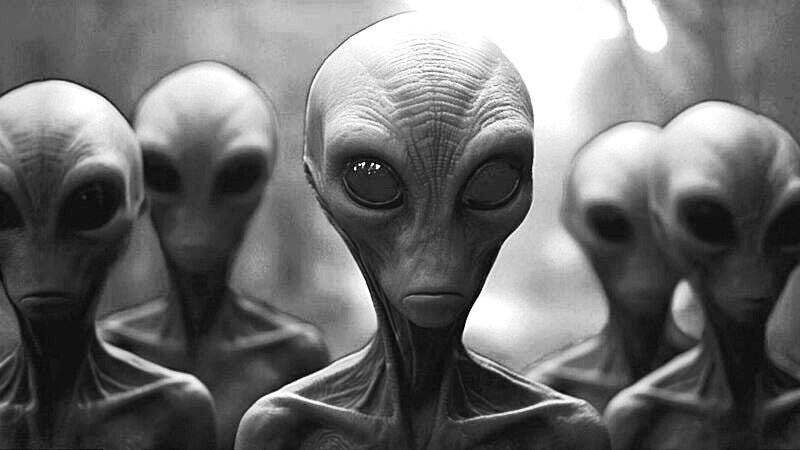
Ahrimanic Gallery
The nerve-sense system is the bodily correlate of abstract, calculative thinking. Ahriman (depicted on the top right as a sculpture done by Rudolf Steiner) works by hypertrophying intellect while severing it from feeling and will. The enlarged head symbolizes consciousness becoming cold, detached, and mechanized, where thinking dominates the whole human being instead of serving an integrated spiritual life. The marvel character MODOK (depicted top left) visually embodies the Ahrimanic imbalance Steiner warns about: a hypertrophied head (abstract, calculating intellect) mechanically sustaining a diminished body, symbolizing intelligence as severed from the other activities of the ego/I. Grey aliens (depicted bottom) repeat the same. Enlarged heads signify hyper-intellect, while small hands and bodies indicate the atrophy of will and feeling under a one-sided dominance of cognition. Note: this is not a claim that the above figures are Ahrimanic (well, aside from Ahriman of course), it is only to point out the forms they take express an imaginary coherence which signify certain relations between intellect, other activities of the ego, and embodiment.
Multiplicity Band-Aid
Faced with the devastating inadequacy of the monolith IQ score, for example its inability to capture creativity, wisdom, social skills, and morality, the modern paradigm does not reconsider its foundations. Instead, it performs the classic move of a failing ideology. It multiplies its errors and reproduces them. This is done by stepping back from the “one” score, and stating that in reality, there are multiple “scores” for the multiple “intelligences”. The retreat from the single “g” factor, to the theory of “multiple intelligences” is certainly not progress, it is the desperate attempt to preserve the core reductionist project of conceiving the mind as a quantifiable collection of measurable traits by fragmenting the trait of “intelligence” into more pieces when the original “concept” proves too elusive. There is a fundamental category error at play here. The domain/medium in which intelligence “operates” is mistaken for a distinct type of intelligence. This is as ludicrous as saying there is a “hammering” intelligence, and a “sawing” intelligence, rather than the recognizing a source in both actions as a unitary mechanical understanding applied to different tools. The manifestation of a faculty is not a separate faculty, and so listing applications of intelligence and pretending that these are in fact a result of the theory of the applicator is empty posturing. Not entirely empty, since it perfectly mirrors the fragmented, dissociated, consciousness of the modern age at its endpoint. Having first shattered the living world into dead matter, and then shattered the living subject into a solitary intellect, it now shatters intellect itself into a checklist of intellects. Hyper-specialization of this kind is the bureaucratic mind’s last refuge in the face of the problem of quality. If you can’t measure the whole, then you subdivide it until you can measure the parts.
This is where we must re-assert the unitary character of intelligence, grounded in our initial exploration of the concept. Intelligence is not six or seven different things. It is the singular core capacity to discern. What varies is not the intelligence, but the field in which it reads (math, social scenarios, kinesthetic), the tools it uses (logic, ideally empathy, rhythm/awareness of the body), and the familiarity one has with the previous two. The musician who perceives harmonic tension, and the mathematician discerning a numeric contradiction are employing fundamentally the same faculty of intelligence. The difference lies in the pattern and the mediums. Furthermore, the fragmentation is not benign. It reproduces and diffuses the same normative implication that IQ, with the monolithic “g”, did. The single-value model created a blunt hierarchy of intelligence. “If there are higher and lower intelligences, then it necessarily follows that individuals with higher intelligences should be valued”, whatever that means. Operationally, it acted (and continues to act) as a perfect tautology for those who wish to take its result and vindicate this or that theory of man and intelligence. In assuming a taxonomy of general cognitive worth (“g”) and designing puzzles to isolate and measure it, it uses the resulting scores as proof that such a taxonomy is real, mistaking its operational definition for a discovery about nature. The multiple-intelligences model, in response, creates a sprawling map of ranked categories. All it does is expand this process. It creates a taxonomy of separate mental modules, then designs domain-specific tasks to measure them. After that, it uses these results to validate the initial compartmentalization. In both cases, the test’s designs predetermine its conclusion. The underlying impulse remains unchanged, this being the compulsion to sort, label, then compare. Whether claiming a group excels in “mathematical” intelligence or lacks in “spatial” intelligence, the framework still traffics in the implication of normativity. It provides a more nuanced, albeit culturally sensitive, lexicon for that same old project of cataloguing human worth by type. This is the more polite 21st century face of the much older logic which believes that human minds can be definitively taxonomized, and that these taxonomies justify social and educational destiny. Generalities certainly do exist, but only as the result of process. It is never a revelation of innate type. The observation that populations exposed to generations of colonialism, resource deprivation, and the deliberate destruction of their own cultural-linguistic frameworks might, and generally tend to do, perform differently on tests designed by and for another population group even within the same ethnicity (say for example an educated class versus a working class which does not have the same opportunity for education or resources), let alone between different cultures. At this point, the IQ test is a number which reflects the culture and access to resources one’s parents have. For example, to look at the lower average scores of Haitian and Somali populations and conclude something about “African intelligence” is to commit the gravest error of the Ahrimanic paradigm. The effect is confused for the cause. The cause is not a cognitive deficiency, the cause is the legacy of material dispossession, lack of education, and cultural disorientation. These generalities, far from vindicating a taxonomy of racial or ethnic intellectual worth, should be read as indictments of the very systems (colonial, economic, and now psychometric) that created the conditions for the disparity and then designed the instrument to measure its consequence as if they were its origins. To see the score and believe in something like this is to be fooled by the most insidious of self-fulfilling prophecies and out oneself as not having the capacity to make the IQ test intelligible to themselves. In other words, it is the sign of an unintelligent person.
The Future of Intelligence
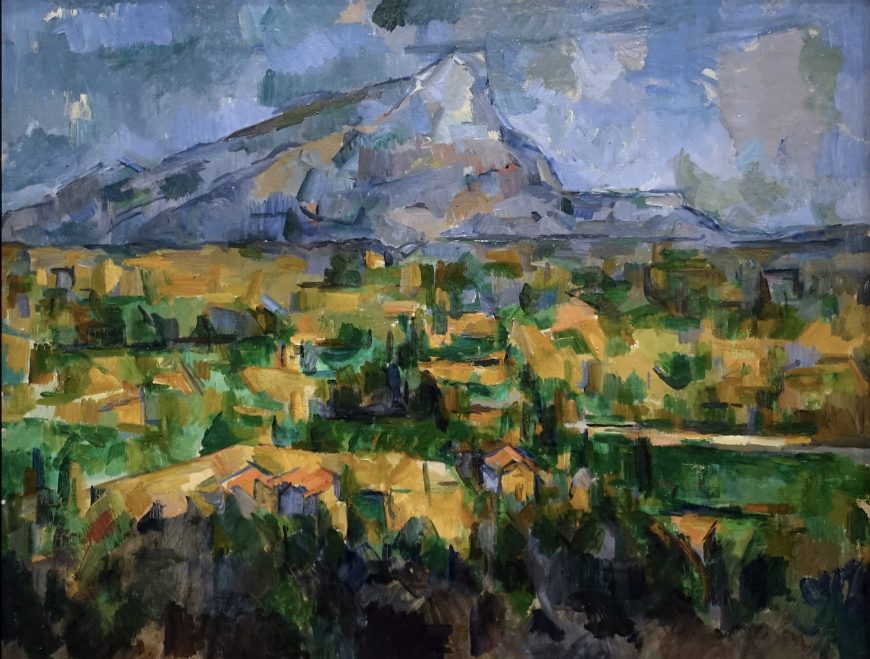
Mont Sainte-Victoire series by Paul Cézanne
Cézanne here is painting the act of perception itself.
The sovereign “I”, or the Consciousness Soul as Steiner would call it, is left analyzing a disenchanted world, leading to alienation as well as this understanding of what constitutes “intelligence”. If the modern error is to substitute the abstract metric for the living faculty, then any path forward must return to the act itself. The solution to the IQ paradigm, this current understanding of intelligence, is certainly not to design more abstract tests. It lies not in a refinement of metrics or further retreat into positivism. The answer is to remove proxy altogether. We must stop trying to simulate intelligence in a vacuum and instead test it in situ by evaluating the performance of the action that constitutes it. This means shifting our focus from the disembodied skill of “pattern recognition” to the more concrete act of, for example, deciphering a historical text’s latent causes, or diagnosing a complex system. Instead of attempting to measure “abstract reasoning” through logic puzzles, the test of abstract thinking would be engaging in the works of Hegel, where intelligence, or intelligibility is demonstrated in the faithful following of thought in abstract thought. In such a framework, assessment almost becomes inseparable from education and practice. You’d never measure a surgeons’ intelligence with a paper quiz on anatomy (although I’d hope they know their anatomy). The assessment is done by observing it in the theater and viewing how the surgeon integrates knowledge and sensorimotor skills, with on-the-fly Judgment under pressure. Nor would you measure the capability of a basketball player in playing basketball with their squat and push-up limits. You would assess them by doing the activity of interacting with a ball. Intelligence as being the capacity to make things intelligible can only be authentically evaluated when it is engaged in the actual work of rendering a real context and content intelligible. The move from abstracted metric to enaction is the first step out of Ahriman’s cage of quantification, since it respects intelligence for what it is as a relational event. What the future of intelligence necessarily requires is to go beyond the paradigm of this kind of measurement altogether and into a comprehensive reintegration. Firstly, a healing of the subject-object split that defines modern consciousness is needed. The individuated “I” (subject), having fully won its sovereignty, must freely choose to reunite with the world (object) in partnership. The goal is to retain the modern ego’s clarity and analytical power, while shedding its alienation from the world and thereby regaining a participatory, living connection to the world. In the future, intelligence will no longer be a number on a sheet, it will be recognized once against as a quality of relationship manifest in action and creation. The future of intelligence advances to what Rudolf Steiner foresaw as the next stage of consciousness: the development of the spirit-self. In the future, the status of the conscious “I” transforms. Having fully secured its individuality and analytical power through the modern “consciousness soul”, it will now turn these capacities outward with a new intention. The “I” will not experience itself as a spectator locked inside a skull, observing a dead, mechanical, world outside its grasp. Through disciplined inner development, consciousness can and will evolve to perceive the living ideas and spiritual forces actively shaping the world. In this act of perception, there is a transcendence of the passive observation of sense-certainty. It begins with meticulous phenomenological attention to the object. Whether it be a plant or a social dynamic, it does not matter, what matters is not interpreting the thing in front of you as a dead thing, but as a dynamic appearance. The observer then actively engages in a process of participatory thinking, striving to trace the living idea, or spiritual form, manifesting through the phenomenon. One does not impose external theory here. Through a disciplined imagination (which has a specific definition for Steiner), one follows the logic of the object’s own becoming. The questions asked are not along the lines of “what causes it?”, they are asking along the lines of “What is its inherent necessity? What spiritual form reveals itself as this particular phenomenal form?”. In doing so, the thinker’s consciousness aligns with the generative principle of the object. The subject no longer stands in opposition to a foreign object. By thinking the object’s own formative reality from within, the act of perception becomes the very medium in which the object’s essentiality is realized. The subject-object split is healed in this activity. The subject’s perceiving is the object’s self-disclosure. Thus, a mental illness is not reduced to neural correlates, but understood as a coherent, albeit pathological, shape of meaning and living experience, whose necessity can be discerned in its own terms. True intelligence, now and in the next age, is the capacity for this kind of perception, where the mode of intelligibility consciousness takes is characterized by uniting with the intelligible form in the act of its apprehension, thereby finding the self back into the world, where it never really left.
Our long examination of intelligence has concluded with a reorientation of an old definition. We traced the phantom of our modern intelligence from its origins as an act of making things intelligible to us, to its imprisonment as a quantified score, a journey which mirrors consciousness’s own evolution into the alienated sovereign “I”. IQ, in addition to being a flawed metric, is the perfect character of this deeper spiritual crisis. It is an artifact of a consciousness that has disenchanted the world, and now, in its loneliness, can conceive of no higher purpose than assigning itself an empty label. However, as the crisis reveals a disease, it also reveals a cure. The future of intelligence calls us not to invent a new test or metric, but to undertake a new kind of literacy that renders ourselves intelligible to a universe that is, and always has been, profoundly intelligible. It invites us to step into dialogue with the world, where the most intelligent thing you can do is participate in a mutual revelation of meaning.