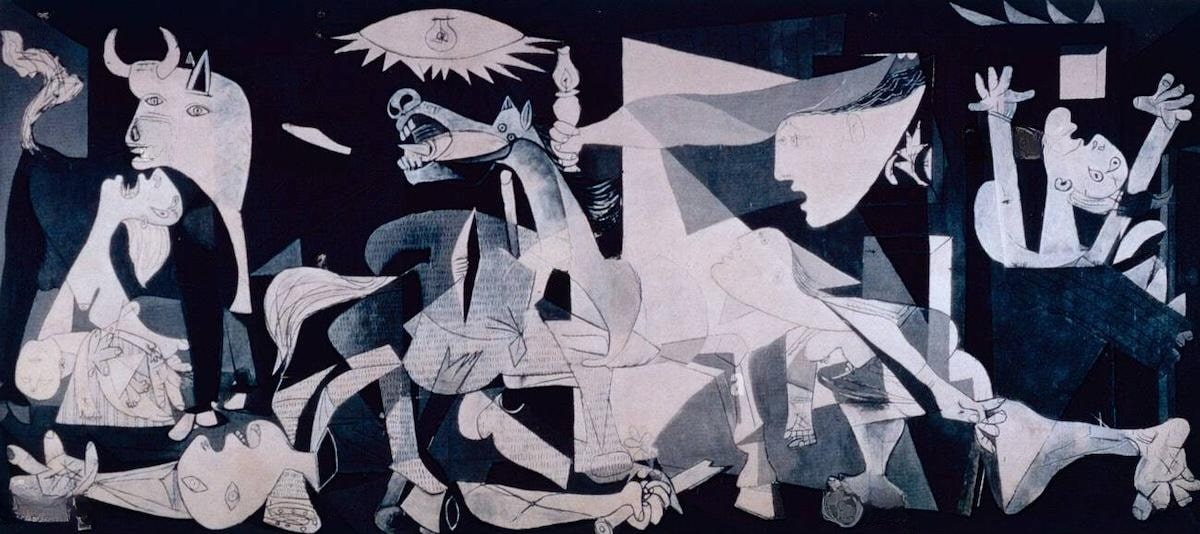
Header: Pablo Picasso’s Guernica
Intro
A brief view of the UN General Assembly might suggest a world of formally equal sovereign units. The reality of the situation is that the architecture of 21st century power reveals a different hierarchy altogether. Global politics is increasingly dominated by the moves of a few big players, namely the US, China, Russia, Iran, and the EU as a collective unity. What distinguishes these poles is not the economic weight or military, although these should not be ignored, it is their continental scale and cultural depth. They operate as integrated civilizational spheres, commanding vast-stretching internal markets and strategic hinterlands which transcend simple national borders. Beneath this appearance, the condition of even prospering smaller states appears with vulnerabilities. Nations like Estonia, Singapore, or Chile, which are celebrated as agile models of liberal democracies or economic miracles (although a few questions problematize this depiction. Economic growth for whom? Liberal democracy in what sense? Singapore is a technocratic bourgeois state managing labor for capital efficiency, contingent on being a strategic port embedded in global finance and logistics networks, and a beneficiary of Cold War geopolitics. Chile is an experiment in neoliberalism under U.S. backed dictatorship, integrated and benefiting from the IMF and World Bank, with a Post-Pinochet landscape finding privatized pensions, education, and water, extreme wealth concentration etc. The “transition” to democracy preserved neoliberal relations, and in no sense was it democratic. Estonia is a laughable example of success, they are a peripheral experiment rather than a sovereign node in the world. Capital here is guaranteed by EU/NATO integration with a brain drain exporting labor to the “imperial core”, so in no sense is this agility replicable. These countries are, in effect, successful for capital on the one hand, and used to discipline other societies on the other) grapple with pervasive insecurities. Their economies are sensitive to global changes in finance, be it supply chains or investments. Their digital infrastructures are continuously exposed to cyber campaigns that can emanate from state actors with resources orders of magnitude larger. Their security is contingent on alliances that constrain autonomous action. Their domestic cultural markets are inundated by the platform ecosystems and media outputs of the great blocs aforementioned. Sovereignty, for them, is increasingly a negotiation contingency.
This shift is mirrored in a rhetorical evolution. The language of international relations is slowly but surely transitioning away from the discrete calculus of national interest, to the grander defense of holistic ways of life and world orders. We hear of the Chinese Dream of national rejuvenation, grounded in more than 5,000 years of civilization. We hear of the Russian World (Russkiy Mir), similarly bound in a common history and Orthodox tradition. Of a free and Open Indo-Pacific, which is responsible for upholding a particular liberal narrative. Even the once universalist “West” now functions in a discourse as a distinct civilizational faction facing challengers and outsiders: read more on that here. What this change in language signifies is a conceptual shift where politics is being framed from the competition of countries, into organizing visions of society and historical meaning. Of these concurrent trends, whether it is the aggregation of power into huge blocs, the pressure on smaller states, or the reflective turn in political rhetoric, the situation at hand prompts a question regarding the structure of the state. In order to answer this question, an elaboration on what the “state”, and waving away it’s equation with “nation-state” is necessary. The latter is not the default setting of political organization, nor has it been historically. It is a relatively recent phenomena. We can distinguish between two types of states for the purposes of this essay: the Nation-State and the Civilizational-State, with the 20th century ideological super-state (emphasized by the communist project) revealing of a novel particularity.
Modern Forms of State
The nation-state’s (hereby referred to as nation) core principle is the claimed congruence of political sovereignty with a homogenous national identity. This identity can be rooted in ethnos (shared ethnicity, language, descent) or demos (a civic persuasion of shared laws and participation), but the logic remains one of singularity. The internal process is unification, assimilation, and the active creation (often through standardized education or propaganda, or conscript armies, etc.) of a singular people within defined borders. It’s highly important to note that this form is a historic novelty. It is a product of post-Westphalian Europe, perfected via 19th century romantic nationalism (e.g.; Germany’s unification under Prussian leadership, or France’s Jacobin project of turning peasants into Frenchmen). The global proliferation of this form was a function of colonialism and coercion. As European imperial powers operated as nation-states at home, they imposed the Westphalian state system on their colonies, carving arbitrary borders that ignored indigenous political and cultural distinctions. Upon independence, these new states were forced to adopt the nation-state template to participate in the international order. This process was, and still is, reactionary and inherently violent, requiring the top-down construction of a national mythos often from disparate ethnic groups, which can be considered a kind of internal colonization necessary to compete in a system they did not create. France (post-1789) and Germany (post-1871) stand as the perfect examples of nation-states.
In construct stands the civilizational state. The core principle of this form is the alignment of sovereignty with a self-contained civilization. Meaning and organic meta-culture that encompasses and hierarchically orders multiple ethnicities, languages, and regional identities. The unity here derives from an integration under a dominant civilizational core, defined by a shared foundational mythos, philosophic worldview, and a sense of historical continuity within some broader project. The internal logic here is not the assimilation into sameness, but the management of plurality under a central political authority which acts as the guardian of a perennial civilizational order. Pre-modern China is the best example here, operating under the Mandate of Heaven (Tianxia) as a civilization which cognized itself as the world, governing a vast expanse through “meritocratic” bureaucratic elitism (such as the Confucian exam system), as opposed to ethnic Han primacy. Tsarist Russia similarly expanded as a multi-ethnic, Orthodoxy-led empire. The Ottoman Empire organized itself around Islamic law and the Sultanate, as opposed to the Turkish ethnicity alone. These polities are defined by their scale, absorptive capacity, and self-conception as unique, enduring universalities (and likewise individualities).
The 20th century introduced a disruptive necessity as a reaction to modernity. We may call it the “ideological superstate”. This model explicitly rejected both the ethnic nationalism of the nation, and the traditional civilizational hierarchies of empires. Its core principle was an ideological universality which put ethnicity lower on the totem pole (and in some cases can be considered post-ethnic, however this possessing morphological similarities to the civilization-state requires that it not dispense with ethnicity. It just doesn’t center ethnos as the unifying glue). Projects like the USSR and Maoist China aimed to dismantle traditional loyalties to clan, tribe, religion, and in some cases ethnicity, and replace them with a new, synthetic identity based on class consciousness and party discipline. The goal in the USSR is the “New Soviet Man”, a product of collective social engineering for the purposes of collectivization and industrialization. To view the USSR as a “Slavic” state or China purely as a “Han” state is a profound category error, projecting a nationalist framework onto a system designed to destroy that very framework. In these states, ethnicity was treated as a bourgeois relic to be superseded or a tactical administrative category (as in China’s minzu system). Unity in this form is derived from ideology and shared participation by the collective sociality (and subsequently the productive machine). This represented a flawed, but ambitious attempt to leap beyond both previous forms into a purely modern, politically constructed totality, one that has shaped the entire world, and that we are still feeling the effects of. Its erosion and the subsequent search for new sources of legitimacy in Russia and China have directly prompted their conscious re-articulation as civilizational states today.
Communist states (aka ideological super-states) failed as enduring political forms for internal reasons and historical pressures. The core failure can be described as a tension between universalist ideology and the persistent particularity of being. The project of erasing bourgeois relations found in ethnicity, religion, or kinship, and replace them with class consciousness proved to be a project which people resisted. The state demanded an abstract loyalty to a future goal, but could not permanently supplant deeper, pre-existing civilizational and ethnic identities, which it was often forced to administratively manage. The responsibility for this project seemed better to fit the state itself, while being replicated and echoed by subjects. Furthermore, the models’ legitimacy was somewhat brittle, hinging on continuous material delivery (and expansion which, surprise surprise, is not a feature of capitalist state forms but of all modern state forms) and ideological fervor being replicated in subjects. Unlike the nation, which could appeal to primordial ties (ideologically it is functionally primordial, otherwise the state would have to contend with its own mortality) or the civilization-state, which could invoke some continuity of tradition, the ideological super-state offered only a promised future of material abundance and historical vindication. When economic stagnation set in, and when the revolutionary fervor faded, the entire basis for loyalty and sacrifice evaporated. There was no fallback identity, only a disenchanted present, leading to a crisis of meaning and political cynicism that the system was unable to address (which may take the form of looking back fondly on the USSR or similar communist states for the problems they were able* to solve). Finally, the super-state was ultimately vulnerable to the forces of globalization and informational exchange that its closed borders couldn’t withstand forever. The weakness of the “state” and the strength of the “Iron Curtain” were at odds, and when it fell, the global flow of capital, cultural products, and ideas in the late 20th century became an alternative and eroded the state’s monopoly on truth. Upon this erosion of the state,its constituent societies defaulted to more resilient sources of identity, reaching back to pre-ideological substrates of civilization or nation to fill the void left by the collapsed ideology.
The nation does not fare any better. There are two converging axes which emerge as issues for the structure of the nation state. The first is the external return of a disruptive historical logic, and an internal contradiction in social cohesion. Externally, the nation is confronted by the long term consequences of its own colonial and imperial past. The model, being globalized through a process of violent imposition and social disassembly aborad, created extractive and fundamentally unfree political economies. The instability and displacement this engineered now recoils on the metropolitan cores in the form of demographic movements and the importation (which is really a manifestation of inner atomization. This will be explicated soon) of social atomization. States that derived cohesion from a myth of insular homogeneity must now manage the human outcomes of their own historical project of global disruption, challenging their capacity to maintain a unified national narrative. Internally, the nation suffers from a poverty of social ecology; a lack of a realized actual social substance. Whether grounded in ethnic sameness or civic creed, its promise is a unified “people”. Yet, neither basis reliably generates an enduring substrate required for sustained cohesion. Trust is not a passive product of shared identity, it is an active achievement forged through the mediated negotiation of difference within shared conditions. In this sense, the nation logically leads to liberal multiculturalism as a step above the immediate unity of sameness. Meaning a unity of peoples that are different, if it is a true unity, is a unity that finds its ground in something ideal, and has infinite integrity compared to a unity compared in natural contingency (such as being the same ethnicity as another). Unfortunately, the procedural frameworks of liberal nations, focused on abstract equality and recognition, often fail to facilitate this genuine negotiation, leaving material and social rifts unaddressed. When this happens, the purported national unity fragments, retreating into tribalisms and shallow consumer citizenship, thereby hollowing out the model’s legitimizing core from within. Thus, the nation-state is caught in a pincer movement. Pressured from without by the returning consequence of its historical actions, and fraying from within due to its inability to fulfill its foundational promise of authentic communal solidarity, this dual vulnerability points to a model approaching its functional limits.
The Passing-Away of the Nation State. Small Countries Don’t Exist!
The Civilization-State stands alone as the enduring form of political governance, making a resurgence. The process of political forms is always a series of adaptation to conditions and a mirroring of the age. Likewise, the “conditioned” of the civilization-state form is scale. The integrated informational systems of modernity have rendered the classical sovereign nation an increasingly vulnerable anachronism. To compete, let alone secure itself and maintain cultural coherence, a political entity must now command continental resources, internal markets (in the form of having a governing body ultimately having the final say in market determination), and a civilizational identity (in addition to nukes, although this inclusion might upset some people. Nonetheless, it is true). These are the pressures increasingly conditioning towards a convergence to the civilizational state model, whether explicitly, or implicitly.
The standalone nation, particularly that of modest size, is being functionally hollowed out by a few pillars of modern power. Technology and security have been redefined. National defense is about cybersecurity, satellite networks, and intelligence (and increasingly about what is termed “artificial intelligence”). Sovereign capability in these domains requires immense capital, and large proprietary pools of data for machine learning, and integrated, advancing industrial bases. These are resources that are simply inaccessible to smaller states, making them perpetually dependent on consumers in another power’s technological ecosystem. Additionally, economic resilience now demands a kind of internal diversity. The global market, while generating wealth, has created a systemic fragility where only political units with continent scale diversified economies (including internal supply chains, natural resources, and consumer bases for the consumer market) can withstand economic volatility and coercion such as targeted sanctions. Smaller nations live in a state of perpetual exposure, with their stability contingent on the strategic calculus of larger blocs. Essentially what I’m saying is that small states can’t exist in an era where sufficient reach of technology, communication, and influence also exist.
Additionally, and a more subtle aspect, is that there is a battle for cultural-informational sovereignty. The global “public square” is owned and operated by a handful of American and Chinese platform corporations. For a society to maintain control over its cultural narrative or political discourse (in modern societies, the digital common area is akin to the social fabric), it must have the capacity to regulate these foreign giants and potentially host alternative narratives. This is only feasible with a unified linguistic and cultural market numbering in the hundreds of millions at least (don’t take this number literally, it is only to emphasize the scale). Without this scale, a nation’s digital psyche and markets are colonized by foreign algorithms designed for engagement, as opposed to social cohesion taking the form of supporting domestic markets and social wellbeing, inevitably eroding the shared identity that a given nation claims to protect (or even civilization-state, since what is described is a normative reality for any functioning state). Scale is a prerequisite for meaningful sovereignty in the modern day.
Confronted by this situation, even the archetypal nations are being forced to adopt the logic and posture of civilization-states to retain relevance and sovereignty. Consider France, the Jacobin nation built on universal citizenship and the active assimilation of differences into a singular “Frenchness”. Today, it projects power not only as a republic, but as a guardian of a Francophone civilizational sphere. Its rigid concept of laïcité (secularism) is promoted as a universal model, while the French language is defended as a vessel for a distinct way of thought. Through the Organisation internationale de la Francophonie, France acts as a kind of decentralized metropole for a global community of French-speakers, in a way which transcends the concept of nationhood, and approaches the figure of civilizational patronage. One can also take the example of India, who is also undergoing a reconceptualization. Founded as a pluralist democracy, it is increasingly articulated under Hindutva ideology as “Bharat”, a civilizational state positing the Indian nation as the embodiment and homeland of a global Hindu civilization, seeking to integrate its internal diversity under this overarching cover. India’s framing of sovereignty is encroaching further and further into a stewardship of an ancient, enduring civilizational order.
The EU can perhaps represent the most informative example, since it is the most explicit and deliberate political experiment. The EU represents the clearest admission that the classic European nation is no longer a viable unit- it is a post-national project aimed at constructing a new civilizational-scale polity by pooling economic, regulatory, and political sovereignty. It creates an abstract “European” identity based on shared regulations (as seen with the “Brussels Effect”), a continental market, and so on and so forth, positioned against other great civilizational blocs. It must be said that this form of unity is abstract, and so will not last forever. If I was a European, I would be a proponent of Kojeve’s “Latin Empire”, since there is actual cultural and traditional continuity to be drawn from in this case. Ironically, Kojeve was the architect of the EU.
While some states adapt implicitly, others explicitly and ideologically reject the nation model, while consciously reviving the civilizational state form. China is a rather refined example. Its scholars and leadership explicitly describe it as a civilizational state, a political entity whose legitimacy and continuity span thousands of years beyond the modern emergence of the nation-state form. The state manages 56 officially recognized ethnic groups (minzu) but within a framework of a unified, Han-civilizational core advanced by the Communist Party. It must be said that this civilizational core is not a regression into the commensurability of the nation form with an ethnos, it is the recognition of an ethnogenesis. After all, the process of ethnogenesis in the very civilizational continuity China claims was left open. It would be moronic to claim that China is the “Han” people, if what is meant is that the success or definite essentiality of China as a state is reducible to the mere fact of repetition in natural contingency. Even China’s monumental foreign policy, the Belt and Road Initiative, is framed as the restoration of ancient civilizational trade routes, rather than a sterilized “infrastructure investment”, in effect, tying its geopolitical ambition directly to the narrative of civilizational renaissance. Russia, having integrated and overcome the failed universalist ideology of Marxism-Leninism, has filled the void with Eurasianist civilizationalism. This ideology posists Russia as a unique “Third Rome”, a distinct spiritual civilization rooted in Orthodoxy, autocratic tradition, and a multi-ethnic empire, standing apart from a decadent “Atlantacist” West. This self-conception directly frames its geopolitical conflicts, such as the war in Ukraine, not as interstate disputes, but as a civilizational struggle to defend its Russian World.
The United States presents an ambiguous case. Domestically, it operates as the world’s most powerful civic nation-state, bound by the constitutional creed of “e pluribus unum”. Globally, it functions as a kind of liberal-universalist civilizational projector, exporting a package of socio-political norms not presented as American, but as universal values. This creates a de facto civilizational sphere (“the West”) but leads to perpetual tension between its particular natural interests and its proclaimed universal mission. The ambiguity is partially dispelled when one realizes that the social substance in America has functionally been overdetermined and captured by capital interests. Even in the political theater characterized by cultural antinomy, the system still does what it does; as much as Donald Trump, who is president at the time of writing, paints the narrative as a return to the civilizational centrality of America (which is left open-ended, and is thus, an empty advertisement slogan, which one again is a reflection of the interests of capital, and its nexus of propaganda — sorry, I meant “PR” firms), education will still be defunded, public libraries and public access information sources will slowly phase away, every aspect of life will be privatized, birthrates will lower, and so on and so forth. The question of America’s nation-state status is still quite a wonder, since the process of ethnogenesis has never reached its conclusion, aside from the fact that it is a perpetual process. There is no “American” people like there are Russian Slavs or Chinese Han. America has always been marked by waves of immigration, finding institutional representation in the various racial categories: the Black Belt in the South, the Latinos near the border and Western America, the various Native groups dotting the country, and the “Whites” throughout the country, who have given up their previously cultured lives in exchange for abstract unmanifested personhood. Enough about America, we will have plenty of time to analyze her in other articles and videos.
The analysis above necessitates the decisive clarification that only European-derived states like France are “true” nation states in origin. The form of the nation itself was the novel product of the European development, mirroring the emergence of the Consciousness Soul. It emerged from the Peace of Westphalia and was perfected by the modernizing states like France and Germany. This model was then violently grafted onto the rest of the world, with no regard for organic and indigenous political or cultural distinctions already present. Therefore, the current global crisis of the nation is deepest in post-colonial regions, where the form was always an ill-fitting imposition. Yet, as demonstrated, even its European birthplace is not immune. France today can only assert its sovereignty by operating within the larger, implied civilizational framework of “Western Europe” and the transatlantic alliance, leveraging a shared heritage of Greco-Roman philosophy (particularly Plato and Aristotle) and Christianity. Its national project is not nested within this broader civilizational project, conclusively establishing that in the face of modernity’s demands, the political logic of the civilizational state has become an inevitability.